
Althea Romeo-Mark

Medellin is a city where poets are rock stars; a city where the masses hunger for the words of poets, a city where people sit in
the rain and listen to poets; a city where fans line up to get autographs and
take photos with poet-stars. The poetry festival has become a tradition and is
part of the social and cultural fabric of sprawling Medellin.


 |
| XX FESTIVAL DE LA POESIA DE MEDELLIN: lectura en Medellin Lectura en el Ateneo Porfirio Barba Jacob Poetas: Javier Campos (Chile) - Consuelo Hernandes (Colombia) - Fabiano Alborghetti (Suiza) - Leon Gil (Colombia) Jenny Tunendal (Suecia) Althea-Romeo-Mark (Antigua) - Obedia Michael Smith (Bahamas) By:Fabiano Alborghetti |

I did my last reading on Friday, July 16th in
Auditorio Edificio Torre De La Memoria in Municipio Sabaneta about 40 minutes
outside Medellin. We got caught in a horrific traffic jam and arrived 30
minutes late. Read with poets Umberto Senegal (Colombia), Homero Carvalho
(Bolivia) and Esteban Moore (Argentina).

It is Sunday, 18 July and I missed the final day of
the festival which will feature readings by all poets and a grand party
afterward. I had to get back to reality since I don't write for a living. Many
poets attending the festival get paid to do what they enjoy--write and teach
writing, take on projects that might change the world in some small way,( i.e.
preserve dying languages, collect the war stories of women), and perennially
attend poetry festivals around the world. It is a lifestyle some of us only
dream about. Not all of us can live on poetry. Work starts on Monday at 9:00
a.m.

I am going to miss the bustling city of Medellin. Rainbow-colored
buses that make you think of carnival, herds of motorcyclists, streams of
yellow taxis and private cars compete in that city where the smell of gasoline
in predominant. One must reach outside
the city to get fresh air. It is a city that is exploding with development, a
city filled with contrasts. There are looming skyscrapers as well as scrappy
narrow building whose doors are protected with iron bars and in which the
ordinary people run their business. There are huge shopping malls on the city’s
outskirts along with inspiring museums, wonderful architectures and
universities. The mountainsides are
painted brown with clay/brick buildings large and small, fantastically designed
or hurriedly erected structures build by refugees of war.


It is a city where spring is perennial and that means
rain and rain coats, and streets filled with vendors selling fresh fruit and
avocados where ever you turn. I am going to miss the fresh fruit and vegetables
and fresh juice that we were served every day—soursap juice being my favorite.
I hope to shed the few pounds I think I gained.

I am going to miss Fernando Rendon and his army of
organizers and helpers, some, who happen to be university students artists and
actors, who worked tirelessly as readers, translators, guides, m.c.’s and
shepherds of poets who needed to know where to, when to go and how to get to venues. They also gave their free time to take us on cultural tours. This machine is so well organized; it would
give the Swiss a grand competition for orderliness and precision.

Unforgettable are the meals shared, as poets got to
know each other informally, the friendships formed by the famous and little
known, from all over the world, and the doors that might have been opened
through contacts made and networks formed.
I was especially pleased to meet and
read with fellow Caribbean poets, Grace Nicols and her husband, John Agard
(Guyana), Cecil Blazer Williams (St. Vincent
and Grenadines), Obediah Michael Smith (Bahamas), Domingo Alfonso (Cuba)
and Howard A Fergus (Monserrat)

. We learned to reinforce the faith we had in ourselves and our purpose in this world as the mouthpiece of the masses and the interpreters of our own experiences and that of the silent majority.
 |
| Cecil Blarzer Williams (St. Vincent and the Grenadines) Althea Romeo-Mark (Antigua), Alfonso Domingo (Cuba) Howard A Fergus (Montserrat), Obediah Michael Smith (Bahamas) and Grace Nicols (Guyana) |
 |
| Howard A Fergus (Montserrat), Obediah Michael Smith (Bahamas) and Grace Nicols (Guyana) |
 |
| Cecil Blazer Williams (St. Vincent and Grenadines) Althea Romeo-Mark (Antigua), Domingo Alfonso (Cuba |
 |
| Reading with other Caribbean poets at Teatro Camilo Torres Universidad de Antioquia, Medellin, Colombia Viernes 9 de julio, 4:30 p.m — with Althea Romeo-Mark. |

. We learned to reinforce the faith we had in ourselves and our purpose in this world as the mouthpiece of the masses and the interpreters of our own experiences and that of the silent majority.
 |
| Out and about in Medellin with fellow international poets |
 |
| A Colombian student, translator, and escort who comes from a city that is predominantly black and maintains African roots. |
 |
| In Bucamaranga, near the Venezuela border for a reading and trying some of the local food. |

Hope I will be
back to try the “changua” soup made of potato, egg and bread, the wonderful
tamale cooked in banana leaf cups and munch on “fat ass” ants and remember that
“embarazada” doesn’t mean to be embarrassed but to be pregnant. And I hope that
I can remember that in some parts of the country, “muy caliente” can mean I am
upset or sexy hot. I must see the beautiful smiles of the Colombian people and
become the object of their kind spirit once again.


 |
| Vendors selling fresh fruit |
 |
| Soursap |
Beauty and the Beast Dance a Duet in Medellin
The
clay god lives here.
Red dwellings paint blue
sky-line.
Wedged between steel and
cement giants,
scrappy narrow
structures,
play hide-and-seek in
their shadow.
Bricked barracks, sprung
up like weeds
in the aftermath of
reckless wars,
clutter and cling to steep
mountainsides
and brim over with
refugees.
Clay homesteads, teeter
on the edge of precipices,
line roadsides like lost
itinerants.
Lone figures lean out
the minescule windows
of rainbow-colored concrete
closets,
dream of pennies and
escape.
Herds of motorcyclists and
streams of yellow taxis
clog the roads. Pedestrians
inhale suffocating gas fumes.
Street vendors brave
noise and smoke as they sell
mangoes, lemons,
watermelons, pineapples,
sugar apples and sliced
flesh of coconuts.
Pastry shops, doors
adorned with iron bars,
bloom out of nooks, appease
the hunger pangs
of sweet-toothed passers-by.
In a crowded market,
displaying souvenirs,
a man grinds sugarcane
stalks.
People wait to buy juice
trickling into a pan.
The wealthy retreat in
gated communities
with modern amenities and
live in soap-opera worlds.
Drug lords orchestrate fiefdoms
in the shadows.
Danger and death lurk round
corners.
A black granite library,
a misfit
among random construction,
stretches defiantly
skyward,
to bring knowledge to
the masses.
Medellin, a world
metropolis,
masquerades in a
carnival of contradictions.
The clay god watches
as beauty and the beast
dance a duet.
© Althea Mark-Romeo
02.04.2011


A Poets’
Oasis
(Medellin, Colombia)
Cement seats in the amphitheater are full.
A gripped audience, parasols up,
or wrapped in
plastic covering,
sits hours in
rain.
Caught in the magic swirl of a poet’s realm,
crowd clings to the nectar of word-rush,
as voices, dressed in
rhythm,
do laps through verses.
Ears grasp messages,
eyes lock messengers,
propelled into spoken trance
poets and listeners,
inseparable.


La poesía va desde el centro a los poetas
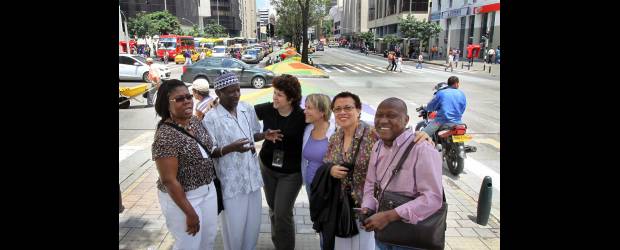
La poesía la dejaron para más tarde. Tal vez se fueron a buscar historias para escribir después. Lo que sí, es que tenían unas ganas gigantes de conocer, de "caminar por ahí", como dijo Verónica Zondek, poeta chilena.
Y se fueron en compañía, conversando en inglés. Patricia Jabbeh, de Liberia; Althea Romeo Mark, de Antigua y Barbados; Verónica Zondek, de Chile, y Lola Koundakjian, de Armenia.
Pasaron la Oriental, con risas y hasta corriendo. Se pasearon por el Parque Bolívar y Junín y se dejaron sorprender por las guanábanas, que no habían visto nunca, y que encontraron en un puesto de frutas. Patricia se puso a bailar en un almacén, mientras miraba ropa, porque ella, según dijo, en Medellín se siente como en casa.
Eso fue la poesía mientras recorrieron el centro de la ciudad. En el escenario, los poetas sí que son sorprendidos. En la inauguración, al ver la cantidad de gente presente anoche en el Teatro Carlos Vieco, pese al fuerte viento y la lluvia, no pudieron dejar de admirarse. Y cuando los autores empezaron a leer sus poemas, el frío desapareció por completo. Así como lo hizo ayer y de seguro lo hará los días que vienen.
Los poetas se convierten en mensajeros de sus propias y lejanas tierras y hacen que la multitud se transporte a los ardientes desiertos del Sahara o respire la fresca brisa de las montañas de Mongolia.
Ya sea acompañados por un tambor o con el único instrumento de la voz, los poetas declaman versos colmados de ironías y tristezas, de amor y muerte, incluso de animales o cotidianidad. A veces tampoco es necesaria la traducción. La gente ríe o hace silencio, y se encanta con el poema.
Y se fueron en compañía, conversando en inglés. Patricia Jabbeh, de Liberia; Althea Romeo Mark, de Antigua y Barbados; Verónica Zondek, de Chile, y Lola Koundakjian, de Armenia.
Pasaron la Oriental, con risas y hasta corriendo. Se pasearon por el Parque Bolívar y Junín y se dejaron sorprender por las guanábanas, que no habían visto nunca, y que encontraron en un puesto de frutas. Patricia se puso a bailar en un almacén, mientras miraba ropa, porque ella, según dijo, en Medellín se siente como en casa.
Eso fue la poesía mientras recorrieron el centro de la ciudad. En el escenario, los poetas sí que son sorprendidos. En la inauguración, al ver la cantidad de gente presente anoche en el Teatro Carlos Vieco, pese al fuerte viento y la lluvia, no pudieron dejar de admirarse. Y cuando los autores empezaron a leer sus poemas, el frío desapareció por completo. Así como lo hizo ayer y de seguro lo hará los días que vienen.
Los poetas se convierten en mensajeros de sus propias y lejanas tierras y hacen que la multitud se transporte a los ardientes desiertos del Sahara o respire la fresca brisa de las montañas de Mongolia.
Ya sea acompañados por un tambor o con el único instrumento de la voz, los poetas declaman versos colmados de ironías y tristezas, de amor y muerte, incluso de animales o cotidianidad. A veces tampoco es necesaria la traducción. La gente ríe o hace silencio, y se encanta con el poema.
http://www.elcolombiano.com/la_poesia_va_desde_el_centro_a_los_poetas-GVEC_96213
http://www.elcolombiano.com/BancoConocimiento/L/letras_para_reinventar_la_vida/letras_para_reinventar_la_vida.asp

No comments:
Post a Comment